Showing posts with label resources. Show all posts

August 30, 2013

Inside Interplanetary: Cities, the Lifeblood of Planets

Looks like a utopia, but they're just resources of the war, really. 
Hi, My name is Sasu and I'm a game designer. Let's discuss some Interplanetary. 

Testing, testing, testing, not much interesting tidbits to tell about. The soundtrack is proceeding nicely and we have some awesome tunes ready for different phases of the game. We're posting the soundtrack bit by bit on our Youtube channel, so take a look if you're a fan of game music, and I know you are!

I can't believe we haven't thoroughly gone through today's subject yet. It's quite a big part of the game. I'm, of course, talking about...

The Cities

I'm sure some of you have been wondering, how exactly to win a match in Interplanetary. While the exact conditions can change around, the basic idea is to reduce your enemy's civilization to ruins. You do not need to destroy all life on the planet, or demolish every single structure; all it takes is to lower the Population of the enemy's cities enough to make them unproductive.

The Cities house the real life energy of the planet: the Population. The Population of the planet is responsible for generating many resources. One of the main features of Cities is their ability to produce Projects. Each city has a certain amount of Project Slots, depending on the amount of Population in them. You may then assign different Projects on the slots and, once again, the Population amount will dictate on how quickly they will be finished. Projects grant certain bonuses. Some are perpetually active, until removed, and others have a one-shot effect.

Blaablaablöpötiblöö.
If a City's Population is low enough, all its Project slots are lost and the city is deemed unproductive until it manages to grow back to its former glory. When all the cities are in an unproductive state, it's game over.

Of course, it is possible to completely wipe cities off the face of the planet, but that would require quite a lot of firepower. Still, sometimes it's better to play it safe; the opponent can, after all, try to help its cities regenerate by different means. There's no thrill like overkill.

The amount of Population in Cities can fluctuate wildly, depending on many things: a catastrophic event may suddenly kill millions, but new citizens do get born all the time. It is possible to encourage the growth in different ways. For example, keeping a City connected to the rest of the world and initiating Projects to boost the Morale of the populace are good ways to give some incentives to breed. Then again, if you're so inclined, why not just clone people? Might not be the best for the Morale, but it kind of gets the job done.

The amount of Project slots, in each city, is shown as a green life bar.
So, to devastate the enemy planet, you need to be ruthless and make the lives of the people as miserable as possible. Persistent attacks give them no time to recuperate and also wreak havoc on the Morale, which in turn affects many things from Production to Population Growth. Even Technologies get developed slower if there are no people to develop them.

There's quite a lot going on there and possibly worthy of a future post, but these are the basics. Just remember to take care of your cities! Don't litter, and so forth.

August 27, 2013

Inside Interplanetary: The Resources: The Material: The Movie

Don't worry, it's just steam. Black, smelly steam.
Yo, everyone! Game Design fellow Sasu is back in action, currently testing the newest build of Interplanetary. Some key features are still missing; it's a little bit difficult to enjoy the game when buildings and cities don't even have life bars, but the game is otherwise quite playable already. Add in a couple of features and balance, balance, balance!

Today we shall delve into a central system, that isn't completely implemented in the game at this point. As such, many of the terms used will probably differ in the final game and the system itself will evolve. In spite of that, let's take a look at the basics of...

The Resources of Interplanetary: Material

We've already mentioned some things about Interplanetary's resources in these posts. There are quite a few, such as Production, Science and Power, but one of the most important ones, for you to keep your eye on, is Material.

Material represents everything, well, material that you need to build structures: concrete, rebar, currency, whatever. It's all lumped under the moniker of Material for your convenience! Along with Power, a bar showing the available Material is always shown to the player; these are the two things that need constant attention when developing your planet.

All those railguns ain't cheap.
As we've explained before, many actions in the game cost Power, the amount of which is recalculated, according to the amount of Power Plants, at the beginning of each turn. Material, however, works more like normal currency, meaning it can easily be depleted, if you consume more than you produce.

The game begins with a set amount of Material for each player, but it won't last for very long. A savvy player will construct a couple of Mines to keep their stocks full. A normal Mine yields a small amount of Material each turn, but they can be upgraded to be more efficient.

The Material doesn't just appear from thin air, though: each planet has a set amount of it, and once it's gone, it's time to start thinking about alternative means of sustaining your development. The planet's Material is divided into three parts: Normal, Aquatic and Deep. The type doesn't matter when building structures, but each of them is acquired in a slightly different way. Most of the planet's Material is Normal and is mined by Normal Mines. Aquatic Material is mined with Underwater Mines and Deep Material is gained by upgrading Normal Mines with Deep Mining capabilities.

Planet Material is like a pizza: tasty and crunchy and I'm hungry.
Initially, all Mines work quite inefficiently and a lot of the mined Material will go to waste in the process to convert it to usable resources. This can be remedied with upgrades, however.

Interplanetary warfare can take a heavy toll on the resources, and you will inevitably run out of Material at some point. When the final drop is consumed, it's time to look to the skies and attempt to colonize a nearby planet. To colonize a planet, you use your interplanetary weapons to shoot Colonization Probes, which in turn will set up a small colony on the planet they land on. The colony is able to, among other things, mine Material and send it back to the home planet.

Long matches may very well end with almost the whole planetary system dry of usable Material. Insert commentary on unsustainable development and the irony of war here.

Hopefully, a complete image on how to play Interplanetary is beginning to form for everyone. We'll be back another time with more tidbits and such. See ya!

April 12, 2013

Inside Interplanetary: Resources

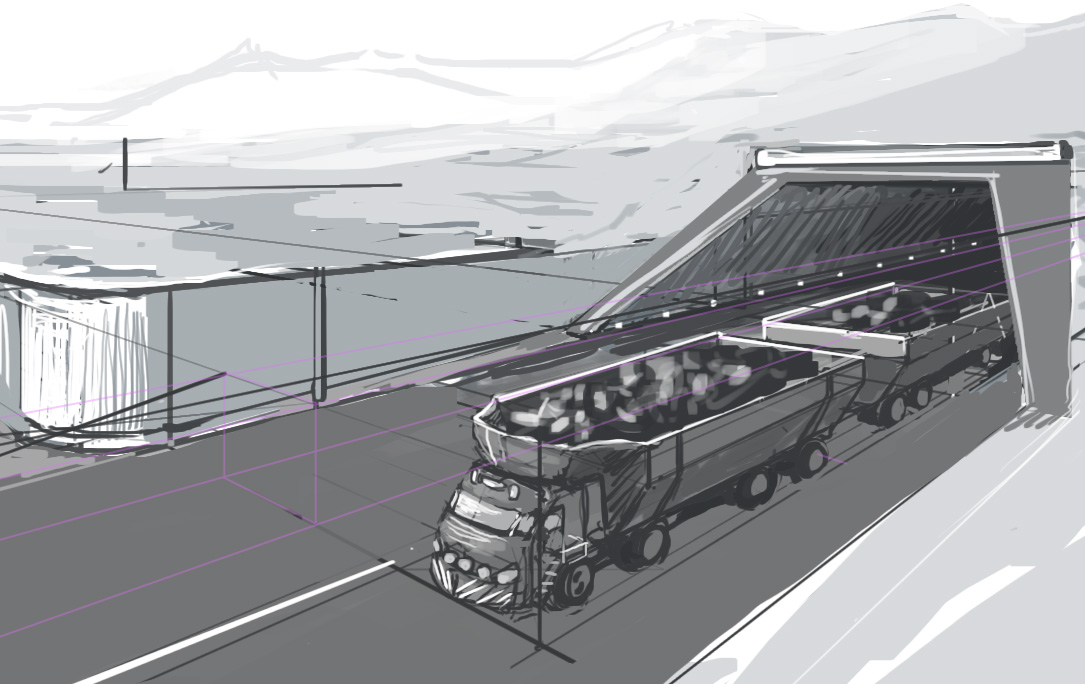
A concept sketch picturing a mining operation.

We thought it would be interesting for many of our followers to learn a bit more about Interplanetary's inner workings, so here's the first of a series of posts that should shed some light on the content and mechanics of the game. Please do keep in mind that some of these are more than likely to change during the development. Feel free to share your thoughts in the comments, you don't need to be logged in to do so anymore!

Resources are key elements in many strategy games, and that's also the case with Interplanetary. There are three main resources in the game, each one pretty different from the others. Here's a more detailed breakdown:

Power
The basic function of Power is to determine how many actions player can commit in a single turn.  Available Power is calculated in the beginning of each turn by adding up the output of all active power plants the player has built. Small amount of Power is also generated by cities. Nearly all major actions, such as firing a weapon or building a building, consume some Power. There are also buildings that use a small amount of Power each turn. Any extra Power the player might have at the end of the turn doesn't carry over to the next one.

A strategic decision player has to make concerning Power might be, for an example, whether he or she wants to go all out at the enemy by firing as many shots as possible, or leave some energy in reserve for defensive actions when the enemy projectiles come flying towards the home planet at the end of the turn.

Material
All non-renewable resources on home planet are represented by a single indicator, Material. There is large, but limited, amount of raw material available on the player's home planet when the game starts. Mines need to be built in order to extract the raw material and make it usable. Unlike with Power, unused Material will carry over when a turn ends. After the home planet is eventually depleted, the only way to get more Material is by launching a successful colonization project, which will still provide only a relatively small amount of Material each turn.

Large amounts of Material are generally consumed when the player builds something. Some other actions use smaller amounts of Material. For an example, a nuclear power plant turns a small amount of Material into a relatively large amount of Power each turn, and shooting a railgun requires much smaller amount of Material than building one.

Just like Power, limited material forces the player to make strategic decisions: It's possible to build a powerful, yet primitive, attack force early in the game by aggressive mining and building early power plants in a large scale, all in order to eliminate the enemy as soon as possible through superior firepower. Another viable strategy would be to develop the planet gradually and wait for more efficient late game buildings, gaining access to advanced weapons with some material left still.

One of the Power/Material bar UI designs from a year back.
Population
Population is a bit of a sneak peek here. It's tied to many other mechanics that will be presented (and hopefully discussed!) later, but let's lay out the very basics:

Population is the number of people living inside the cities of the home planet. Most of the population is concentrated in megacities, that work much the same way as cities in Sid Meier's Civilization series of games. The biggest difference is that other buildings are built outside the cities, not in them. City's population (along with some modifiers that will be presented later) will determine it's productivity and scientific output.

Population of cities is restricted by a global population cap, which is essentially the amount of people the home planet can sustain with current level of technology. As the game progresses, the player is able to research technologies that raise the global population cap and allow the cities to grow larger, allowing the player to more with the city.

Thank you for being interested, more to follow!