April 19, 2013

Designing the Laser installation WMD


Giant Death Laser (work title) preying upon the enemy planet.

Hello to you, dear readers! I’m Jukka, one of the two artists working on Interplanetary. I will be responsible, for the most parts, for creating concept art and illustrations for the game.
In this post I’ll be talking a little about visual design, this time focusing on the "Laser installation" concept.

Our goal in Interplanetary is to make the technologies seem as realistic or feasible as possible without letting the gameplay suffer, so a big part in creating concepts for them is the hunt for applicable technologies that already exist or have been theorized. Luckily our team lead & designer Niklas is something of a "tech nut" so usually he already has some ideas to what might work.

The first step in starting designing the Laser installation, was to type "world's most powerful laser" in Google and hit the search. Quite fast I ran into the National Ignition Facility in US where they conduct research on nuclear fusion with lasers. They use 192 individual lasers all targeted to a small fuel pellet in order to reach the temperatures they aim for. 

So I thought that instead of using a single laser to create a powerful enough beam, it would be more feasible and interesting to have multiple lasers and have some kind of lenses to converge the beams into one. My thinking was, that a tower-like structure could be useful, so that the lasers could be arranged along its length along with the lenses so that theoretically the lenses wouldn't need to bend the beams too much. From that I made the quick sketches below, and later the one on the top.


Earlier GDL concepts. The idea of how they might work has remained pretty much the same.


Another thing to consider was the immense amount of energy needed to fire the lasers. While having it's very own nuclear power plant could be fun, I found out about SMES (superconducting magnetic energy storage), which besides sounding very sciency just might be a feasible way of storing the amounts of energy required... I'm still pondering what I'd do with the design to make it bit more interesting without making it look too unrealistic.

That's it for me this time, but I just might be back writing more of these posts in the future, and once the final concept is done for the Laser installation we'll no doubt be posting it to our Facebook concepts album.

- Jukka

April 12, 2013

Inside Interplanetary: Resources

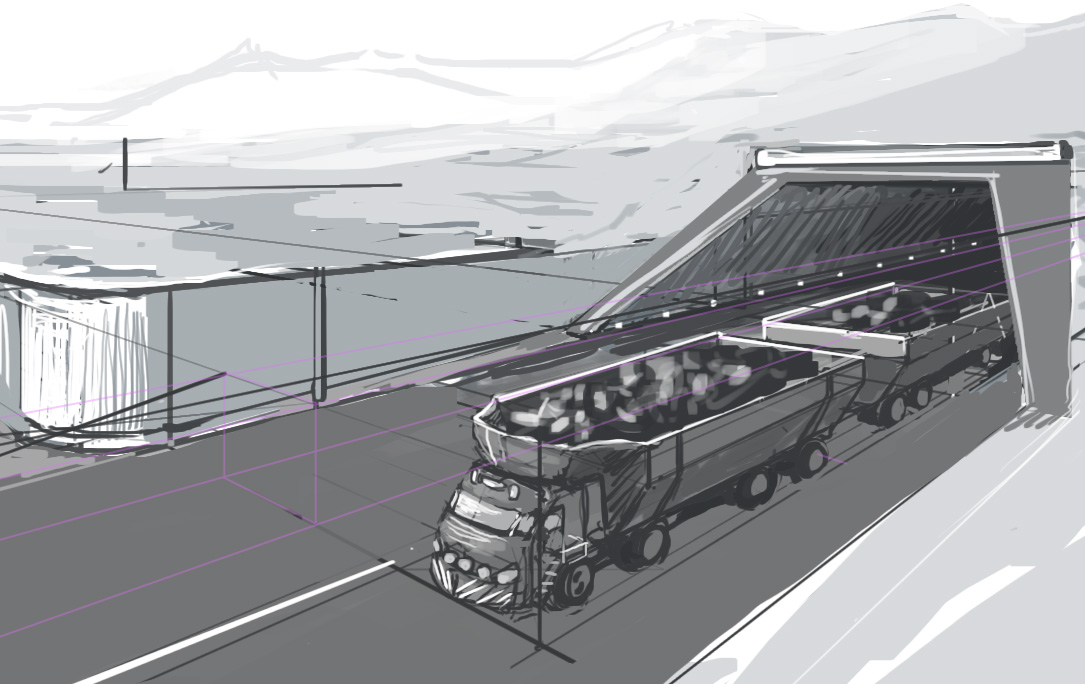
A concept sketch picturing a mining operation.

We thought it would be interesting for many of our followers to learn a bit more about Interplanetary's inner workings, so here's the first of a series of posts that should shed some light on the content and mechanics of the game. Please do keep in mind that some of these are more than likely to change during the development. Feel free to share your thoughts in the comments, you don't need to be logged in to do so anymore!

Resources are key elements in many strategy games, and that's also the case with Interplanetary. There are three main resources in the game, each one pretty different from the others. Here's a more detailed breakdown:

Power
The basic function of Power is to determine how many actions player can commit in a single turn.  Available Power is calculated in the beginning of each turn by adding up the output of all active power plants the player has built. Small amount of Power is also generated by cities. Nearly all major actions, such as firing a weapon or building a building, consume some Power. There are also buildings that use a small amount of Power each turn. Any extra Power the player might have at the end of the turn doesn't carry over to the next one.

A strategic decision player has to make concerning Power might be, for an example, whether he or she wants to go all out at the enemy by firing as many shots as possible, or leave some energy in reserve for defensive actions when the enemy projectiles come flying towards the home planet at the end of the turn.

Material
All non-renewable resources on home planet are represented by a single indicator, Material. There is large, but limited, amount of raw material available on the player's home planet when the game starts. Mines need to be built in order to extract the raw material and make it usable. Unlike with Power, unused Material will carry over when a turn ends. After the home planet is eventually depleted, the only way to get more Material is by launching a successful colonization project, which will still provide only a relatively small amount of Material each turn.

Large amounts of Material are generally consumed when the player builds something. Some other actions use smaller amounts of Material. For an example, a nuclear power plant turns a small amount of Material into a relatively large amount of Power each turn, and shooting a railgun requires much smaller amount of Material than building one.

Just like Power, limited material forces the player to make strategic decisions: It's possible to build a powerful, yet primitive, attack force early in the game by aggressive mining and building early power plants in a large scale, all in order to eliminate the enemy as soon as possible through superior firepower. Another viable strategy would be to develop the planet gradually and wait for more efficient late game buildings, gaining access to advanced weapons with some material left still.

One of the Power/Material bar UI designs from a year back.
Population
Population is a bit of a sneak peek here. It's tied to many other mechanics that will be presented (and hopefully discussed!) later, but let's lay out the very basics:

Population is the number of people living inside the cities of the home planet. Most of the population is concentrated in megacities, that work much the same way as cities in Sid Meier's Civilization series of games. The biggest difference is that other buildings are built outside the cities, not in them. City's population (along with some modifiers that will be presented later) will determine it's productivity and scientific output.

Population of cities is restricted by a global population cap, which is essentially the amount of people the home planet can sustain with current level of technology. As the game progresses, the player is able to research technologies that raise the global population cap and allow the cities to grow larger, allowing the player to more with the city.

Thank you for being interested, more to follow!

April 2, 2013

It's alive!


Good news everyone! TJR has awoken from its slumber of outsourcing and school related stuff. Now that we have also been reinforced with a band of new members, the team is stronger than ever.

First and foremost this means we have been able to finally resume the development of Interplanetary. The project was quietly moved to the notorious slow lane at first last spring and ultimately shelved for a couple of months. This was not something we wanted to do, but by switching to outsourcing for a while we managed to ensure steady supply of ramen while having some time to focus on the remaining school related things and smaller projects. Some of us even managed to graduate while we were flying under the radar, so, success!

Interplanetary has evolved quite a bit when we paid less attention to it; the game is now 3D and based on Unity engine instead of the slowly fading XNA. This should allow us to make the game even more beautiful than we originally planned with the option to go multiplatform with relative ease. Here's a bit of a sneak peek to a description we wrote for the upcoming Kavio cluster website. If you are all "what the heck is Interplanetary??" at this point, this should get you on track of things:

Interplanetary is a turn based strategy game about warfare between two planets. Setting of the game is a fictional planetary system where two planets have evolved intelligent life and ultimately become planetary civilizations. These two planets have fallen into a conflict for the natural resources of the planetary system they share. 
Technology level in the game is not too far from ours, and instead of stereotypical sci-fi starfleets, war is waged with massive, planetary weapons and other megastructures, built right onto the home planet. As the game progresses, technological advances allow more and more options to protect your people and defeat the enemy.
Main part of the game is managing the limited natural resources of player's home planet, developing its infrastructure and researching new technology. Each turn ends with action phase where player gets to target the weapon systems at the enemy planet and unleash his military might. The game supports various different tactics from a planetary broadside of railgun slugs to few, but deadly precise strikes of interplanetary lasers.
If you enjoy games with similar elements, like DEFCON, Civilization series or even the old artillery games, we will definitely have a game for you! Interplanetary will be available in most digital distribution channels.

While actual gameplay screenshots still have to wait a bit, we are proud to present some concept art. Stay tuned, there will be more to follow regularly now that we're back in business.

July 17, 2012

When highscores go global

We have plunged head first into the world of databases and online functionality lately, and while those unlock the possibility to do some neat stuff, there are tons of things below the surface to consider. Data security first and foremost obviously, but what else?

We have been thinking a lot about how people use Internet on their mobile devices. Are they usually on WiFi? What kind of data plan does an average user have? How much data is it ok to transfer each time we, say, download highscore? This article gave us some perspective on the US market, which could be considered our main market area, but we still need to find out how things work in mainland Europe or Russia, both of which are also important to us.

So as much as we would want to see our new shiny database filled with entries, we politely ask the user if they would like to have just an offline highscore funtionality instead.

So this is what we go with right now:


Last week we finalized our newest addition to WP7 catalogue, which should be though the  certification process this week with any luck. More on that later!

July 3, 2012

Maybe we'll stick to indie marketing for now.


So, we made an expedition into the swamp of online advertising the other day. Boring statistics reveal that a) paying for online ads isn't all that effective for a small WP7 developer, or b) we are doing something very wrong. Maybe both, back to the lab!

This week we have been dabbling with SQL and PHP again, programming an online highscore funtionality for another Kajak team. This has been a great opportunity (read: pretext) to rewrite some messy code from earlier, making it easier for us to apply online highscore functionality in our future games as well.

Speaking of which, if things go all right, we will publish a fun little game for WP7 soon! Beyond all the fun the game is also an experiment to see how we can affect the downloads of another WP game by releasing a promotional minigame. We will go into more detail about it in a later post.

June 20, 2012

What is this, a review!?


Hello readers, meet Cripplecat, our new Lumia 610 test device. Since we have been busy with outsourcing projects again this week, we thought we might as well introduce this little thing and share our thoughts about it with a few lines.

If you happen to be a WP7 developer, there are two sides to this device. It's existence will force you to decide whether you want to set some limits to your design, or cut out a portion on potential audience by opting out 256 devices. On the other hand this device offers pretty good bang for the buck, which means it has a good chance to gather more of that audience we ever so desire.

We found 610 to be surprisingly agile little thing. There's no noticeable lag anywhere, and in most cases it performs much better than many earlier devices with 512 memory. However, we ran into serious problems when running the graphics intensive Spiritual on it, and thus decided to make the game unavailable on 256 devices for now. Developing games for 610 shouldn't be a problem though, if the memory usage is well thought out from the beginning. We admit that this has been a bit of a learning experience.

For end users  still without a WP7 device this phone is an excellent choice, especially if you want the best value instead of best performance. There are some apps Lumia 610 will not work with, including Skype, so you might want to check out before marching to the store.

June 11, 2012

Busy busy business


Whoa! Several weeks went by just like that. We are sorry to have missed some blog posts between this and the last one. These weeks have been quite eventful, so lets take a look at some past events:

Riku Leinonen has joined our crew for the next few months, as it turns out our 3:1 ratio of programmers and artists needs even more imbalance. Welcome!

Break MORE Aliens! has been published, and we even stayed on schedule. A future blog post will go into more detail about the publishing process, advertising, reviews ans all that jazz, but right now you can:

Check out the game itself! (If you have a Windows Phone)
Take a look at the official trailer!
And read through this awesome review by wpcentral.com!

We were lucky enough to teach game programming basics last week at Kajaani UAS, very rewarding experience. To all our students, thanks for attending, and keep making games on your own time! To all those who took entrance exams during the week, see you in September! ;D

Along these we have been, and still are, working on some very interesting subcontracting projects.

Next week we will finally begin our grand summer project, stay tuned! TJR out.